The Waterfall Strategy

For real estate, land and business brokers

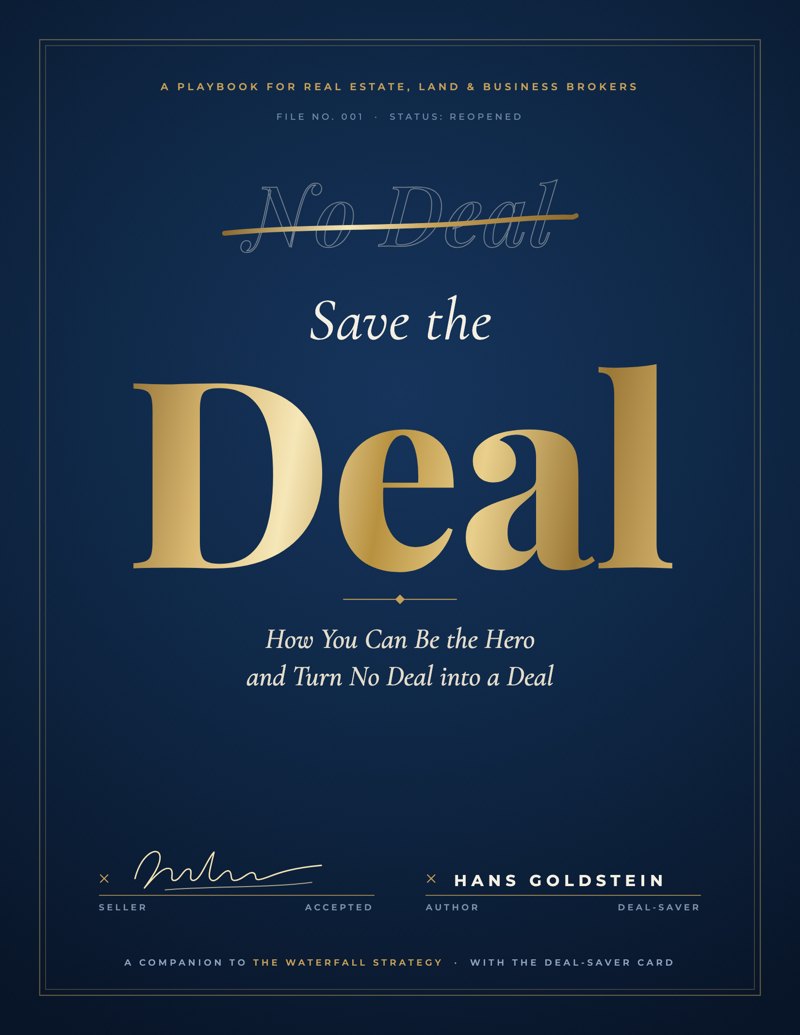
Save the DealHow you can be the hero and turn no deal into a deal

Deals don't die on price. They die at the net. One question at the listing appointment brings them back. Spot it. Ask. Introduce. And unlike a seller carry, in a structured sale the buyer pays in full at closing, so there's cash at the table for your full commission.

Get the playbook free 16 pages, Deal-Saver Card included. Instant download.
The one question

Ask it at every listing appointment.

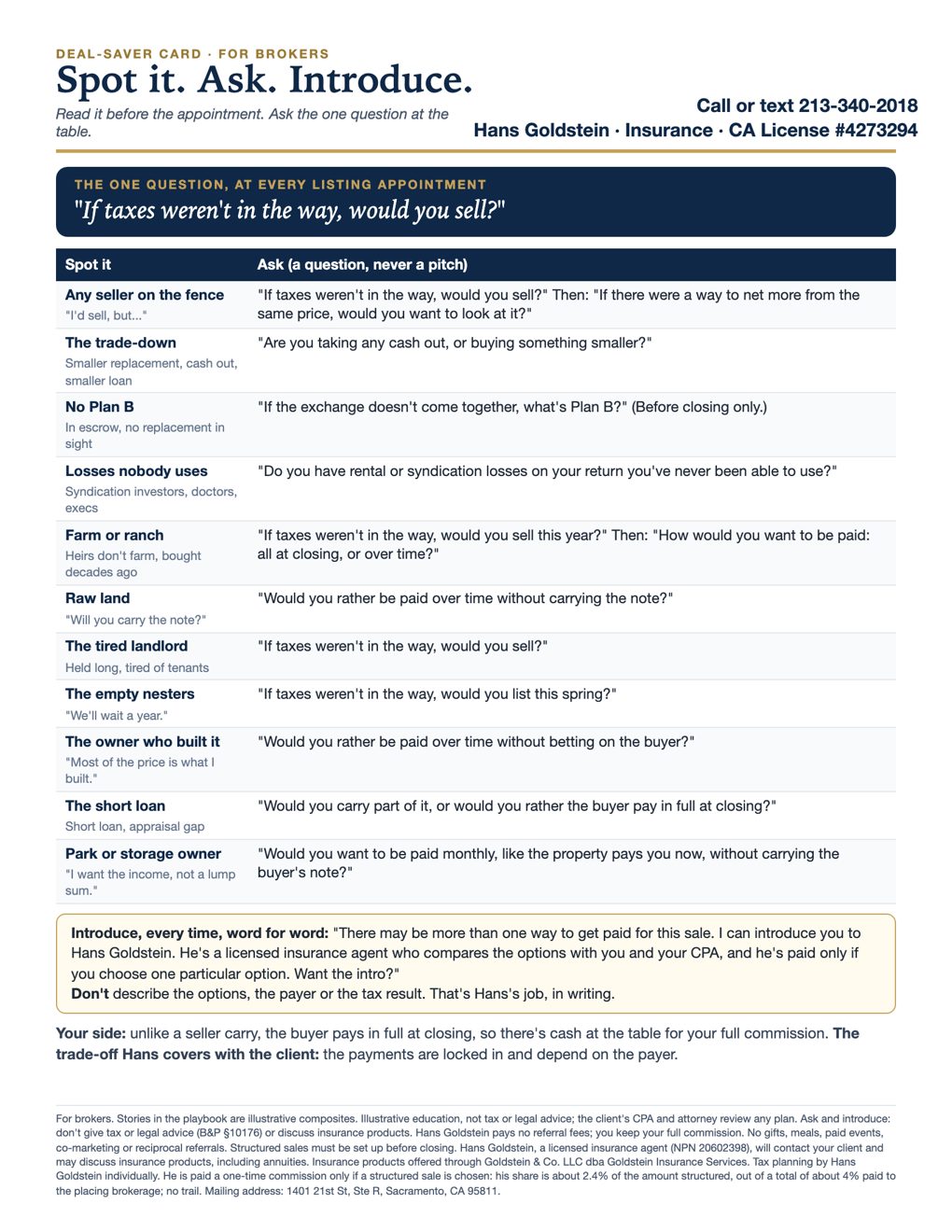
"If taxes weren't in the way, would you sell?"

A yes means the deal is alive. You don't explain tax, describe the options or give advice. You make one introduction, word for word: "There may be more than one way to get paid for this sale. I can introduce you to Hans Goldstein. He's a licensed insurance agent who compares the options with you and your CPA, and he's paid only if you choose one particular option. Want the intro?"

Spot the stuck deal

Eleven plays. Spot it. Ask. Introduce.

Sort it first

Before any play

Is the buyer short on the loan, or is the seller short on the net? A short loan is a financing problem. A short net is where the other plays start.

Any seller on the fence

"I'd sell, but..."

"If there were a way to net more from the same price, would you want to look at it?"

The trade-down

Trading down, cash out, a smaller loan

"Are you taking any cash out, or buying something smaller?"

1031 at risk

In escrow, no replacement in sight

"If the exchange doesn't come together, what's Plan B?" (Before closing only.)

Losses they can't use

Doctors, executives, syndication investors

"Do you have rental or syndication losses you've never been able to use?"

Farm or ranch

The kids don't farm; bought decades ago

"If taxes weren't in the way, would you sell this year?"

Raw land

"Will you carry the note?"

"Would you rather be paid over time without carrying the note?"

Commercial, held long

Tired of tenants, won't write the check

"If taxes weren't in the way, would you sell?"

Luxury home

"We'll wait a year."

"If taxes weren't in the way, would you list this spring?"

Business owner

"Most of the price is what I built."

"Would you rather be paid over time without betting on the buyer?"

Buyer can't finance

Short loan, appraisal gap

"Would you carry part of it, or would you rather the buyer pay in full at closing?"

Park or storage owner

"I want the income, not a lump sum."

"Would you want to be paid monthly, like the property pays you now, without carrying the buyer's note?"
Why brokers like the structured sale

The buyer pays in full at closing. So does your commission.

What it does for the deal (for you, not a client pitch)

  • The buyer pays in full at closing, with normal financing.
  • Unlike a seller carry, there's cash at the table for your full commission.
  • The seller holds no note on the buyer: no foreclosure, no servicing.
  • The 1031 Plan B: written into the contract before closing, the sale closes even if the exchange doesn't.

What to know

  • The payments are locked in: no speeding up, borrowing against or cashing out. That's what protects the timing.
  • They depend on the assignment company's ability to pay; it is usually funded by a fixed annuity from a life insurer whose name and financial-strength ratings are disclosed in writing before anyone signs.
  • In many programs the buyer stays secondarily liable if the payer fails; the documents control.
  • A commission is built into the payout rate, so the rate is lower than a seller-financed note.
  • It must be arranged before closing. There is no published IRS ruling on this specific assignment structure, so the client's CPA reviews the documents.
Four times the broker was the hero

One question. One introduction. One closing.

The trade-down

Tom and Marla found a replacement they liked for far less, and the leftover equity froze everything. Their broker asked, "Are you taking any cash out, or buying something smaller?" and made the intro. Their attorney carved the leftover out in the contract. They bought the building they wanted. Marla sent the broker two referrals.

No Plan B

A retired dentist wouldn't list her office: "What if I can't find a replacement?" Her broker asked, "What's Plan B?" Her attorney wrote both doors into the contract. Two weeks before closing, her only target went to another buyer. She closed on schedule, on the Plan B.

The farm the kids didn't want

The neighbor's son wanted the ground; nobody signed. The broker asked the one question and made the intro. The son financed through his farm lender with a third down and paid in full at closing. The sellers chose ten years of payments, and the son planted that spring.

The one that was a full 1031

A landlord said he wanted out. Side by side, his goals pointed the other way: stay in real estate, no cash needed. A full 1031 won, and that's what Hans told him, with nothing to sell. His broker sold the building and found the replacement.

Illustrative composites: not real people, clients or deals. Many sellers who run the numbers find that cash, seller financing or a full 1031 fits better, and a structured sale does not always net more. The client's CPA runs the real numbers.

Free for brokers

Get Save the Deal and the Deal-Saver Card.

Read it in twenty minutes. Keep the card in your bag. Download instantly, and we'll email you the links.

  • Eleven plays: the signs, the question, the handoff
  • Short stories under each play
  • What to send me, and what happens after the intro
  • A one-page summary for the buyer's agent and lender
  • The Deal-Saver Card, both sides, for listing appointments

Send me the playbook

PDF playbook + printable card.

Used only if you check the box below.

By entering your email you agree to receive the playbook and occasional educational emails from Hans Goldstein. Unsubscribe anytime. Privacy policy.

Hans Goldstein, a licensed insurance agent (CA Insurance License #4273294), will contact you and may discuss insurance products, including annuities.

The ground rules

I don't pay referral fees, and you keep your full commission. You don't give tax or legal advice (Bus. & Prof. Code §10176); you ask one question and make one introduction. No gifts, meals, paid events, co-marketing or reciprocal referrals change hands. I don't touch your deal. Everything is set up before closing, never after, and the client's CPA reviews it.

I'm Hans Goldstein, author of The Waterfall Strategy. I'm a licensed insurance agent. I'm paid only if a client chooses a structured sale: a one-time commission from the insurer, currently about 2.4% of the amount structured (my share of a total of about 4%, paid once, no trail), built into the payout rate. I earn nothing from the sale itself on seller financing, a cash sale or a 1031, unless the client later buys an insurance or annuity product from me, disclosed in writing first. That's a conflict of interest, which is why I show every option side by side. Call or text 213-340-2018.