Cliff Notes
The Waterfall in One Page
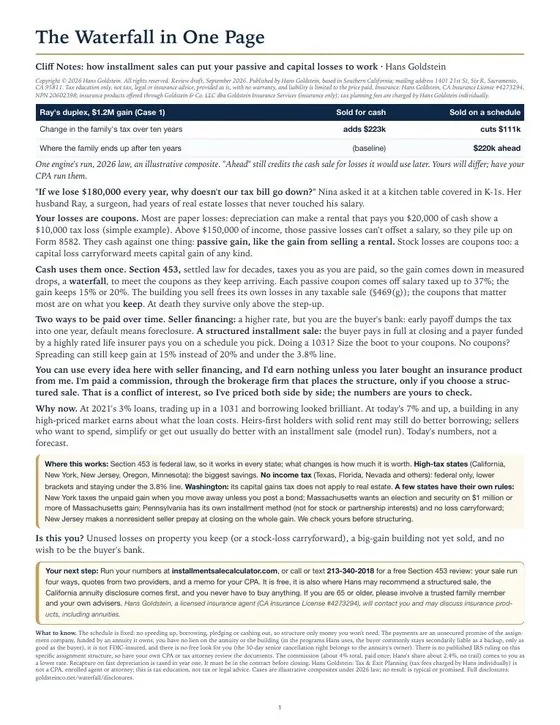
The whole idea, who it fits and who it does not, on one sheet. Start here.
Cash in your old losses now. Get paid over time so the gain in each payment gives new losses something to cancel. Don’t leave coupons in the drawer.
Sell a rental for cash and the gain lands in one year, cashing your stuck losses once. Sell on a schedule and the gain meets them year after year.
In one engine’s run, a surgeon’s duplex (an illustrative composite): over ten years, the cash sale adds $222k to the family’s tax; the installment sale lowers it by $112k, and the family ends about $185k ahead. Same duplex. Same buyer.
A different calendar. The Waterfall Strategy shows how Section 453 does it, two ways, and case by case when it does not work at all.


Produced with AI tools from Hans Goldstein's research.
Then the three-part walkthrough: Part 1, where passive losses come from, Part 2, the dam and the waterfall, Part 3, a carve-out sized to your losses against a 7% loan.
Download the free bookThe Waterfall Strategy in 6 minutes. Produced with AI tools from Hans Goldstein's research.
Many rental owners get cash from a property while the tax return shows a loss, because depreciation is a deduction with no check attached. When income is above the allowance range, that loss is suspended and builds up behind the dam. A hypothetical with round numbers.
IRC §469, §168; IRS Statistics of Income, Pub. 1304 (TY2022). 2026 law. Hypothetical. Not tax advice.
Suspended passive losses are used as passive gain shows up, so spreading the gain over several years can keep a gate open while new losses arrive. A hypothetical with round numbers: it is timing and matching, not a new deduction.
IRC §469, §453, §1031; IRS Pub. 925. 2026 law. Hypothetical. Not tax advice.
Size the cash part of your exchange to your losses, take it early, and keep the replacement free of new-rate debt, then compare it with a 1031 followed by a loan for the same dollars.
Against cash it won every case an independent check ran; against a 7.5% loan it wins when the building grows less than about 2.6% to 3.0% a year and you die holding it, and the loan wins when growth is faster or death comes within about 7 years.
Numbers updated October 10, 2026 after an independent check: see the figures below. The video above uses the earlier model; where it says a break-even of about one percent, the checked figure is about 2% to 3%.
Home equity line average 7.33%, Bankrate, Oct 7, 2026; 30-year home loan 7.40%, Freddie Mac, Oct 8, 2026; Orange County apartment cap rate 5.0%, Kidder Mathews, Q2 2026.
Assumptions: 7.5% rental-property loan with a 1% fee, 0.5% capital reserve, 5.0% on the unpaid balance, 2% structured-sale fee; the pool of losses is a premise to confirm with your CPA. Both paths are 1031 exchanges. IRC §469(g)(2), §1014, §691. 2026 law. Hypothetical. Not tax advice.
Download the free bookUnless you qualify as a real estate professional, the passive activity rules hold rental and syndication losses back. They can only offset passive income.
Year after year, the unused losses pile up on Form 8582. Some owners carry large balances of them for decades.
Under Section 453 you are taxed as you are paid. Get paid over years and the gain comes out in measured drops that meet your losses as they arrive: coupons cashed in on schedule. Timing and bracket spreading, not magic.
Stories first, then the numbers, then the code section. Every case has a "for your CPA" box with cites.
You can use every idea here with seller financing, and I'd earn nothing unless you later bought an insurance product from me. I'm paid a commission, through the brokerage firm that places the structure, only if you choose a structured sale. That is a conflict of interest, so I've priced both side by side; the numbers are yours to check. Details in the disclosures.
Landlords, LP investors, heirs and 1031 exchangers. Each case is a composite with a "what could go wrong" note, and three show the strategy losing.
Why an unlocked loss can come off your highest-taxed income while the gain keeps its capital-gain rate, and the five layers of tax on a sale that decide whether it matters.
Seller financing, or a structured installment sale: the buyer pays in full at closing and you are paid on a schedule you choose, with no buyer to chase. The strengths and costs of each, plus 1031 boot, a 12-question checklist, and what to bring your CPA.
The whole idea, who it fits and who it does not, on one sheet. Start here.
What your stuck passive and capital losses are waiting for. The impatient edition, stories and numbers.
The same rules and engine numbers in everyday words, with a picture on most pages. Tax basics first: buckets, recapture, the 3.8% tax, state tax.
Cash In Your Stuck Losses Before They Disappear. Cash in your old losses now. Get paid over time so the gain in each payment gives new losses something to cancel. Don’t leave coupons in the drawer. Every case, every cite, the technical appendix.
The owner's manual for the years after closing: how each payment is taxed, a month-by-month calendar, four worked households, Medicare and Roth timing, the honest downsides, and worksheets for you and your CPA.
Start with the one requirement: a real gain, usually $300,000 or more, on a sale that has not closed. Then count how many of these are true for you. If two or more are, the waterfall can be powerful and it is worth running your numbers.
Dollar figures are what each item adds to the benefit of spreading in one hypothetical from the book: a couple with $60,000 of other taxable income and a $1 million gain, ten equal payments against all cash (model run, 2026 federal law; Rev. Proc. 2025-32).
Your facts can reorder the list. What points the other way: a one-time balance such as a net operating loss or a stock-loss carryforward favors some cash at closing, and an owner who will hold until death may do better keeping the property. Hypothetical. Not tax advice.
The full ranked list: seven things that help an installment sale, nine that work against it and three that matter less than people think, each with a 2026 example and its IRS source. See what makes an installment sale work, ranked.
Download the free bookSuspended passive losses are rental and syndication losses the passive activity rules in IRC §469 would not let you deduct. Unless you qualify as a real estate professional or fit under the $25,000 rental allowance, they can only offset passive income. The rest carry forward on Form 8582, year after year.
They are released when you sell your entire interest in the activity to an unrelated buyer in a taxable sale (§469(g)). That happens in any fully taxable sale, cash or installment (on an installment sale, in proportion to the gain you report each year, §469(g)(3)).
The Waterfall Strategy is about the other losses: the ones on rentals and K-1 deals you keep, which need passive income to be used. An installment sale supplies that income year after year, so those losses get used sooner and against gain in lower brackets.
The book spends as much time on when that fails as on when it works.
Start here:
Hans Goldstein, who publishes this book as Hans Goldstein: Tax & Exit Planning, reviews structured installment sales for owners selling appreciated real estate or a business, working alongside their CPA and attorney. The structure has to be in place before closing. Email hans@goldsteinco.net or call or text 213-414-2808. Hans Goldstein is a licensed insurance agent (CA Insurance License #4273294) and may discuss insurance products, including annuities; insurance is offered through Goldstein & Co. LLC dba Goldstein Insurance Services.
Rental and other passive losses you could not deduct in the year they arose because you had no passive income to absorb them and did not qualify for the $25,000 allowance or real estate professional status. They carry forward on Form 8582 until you have passive income or sell the activity (IRC §469(b)).
Selling your entire interest in the activity to an unrelated buyer in a fully taxable sale releases them under IRC §469(g). They are treated as nonpassive and can offset other income, subject to later limits such as the excess business loss cap. A 1031 exchange, a related-party sale, or selling one building from a grouped or aggregated activity does not trigger the release.
For federal income tax it can work in principle, but it rarely lands exactly, and it spends every loss at once. Cash or debt relief taken out of an exchange (boot) is taxed as gain. That gain is passive income, so suspended passive losses offset it (Treas. Reg. 1.469-2T(c)(2)). It is an offset, not a release under IRC §469(g). Three things get in the way of an exact match. The loss balance is not final until that year's Form 8582 is done, because the year's results from every passive activity you own are netted in. Boot is not final until closing, and a smaller loan on the replacement property counts as boot too. And your state may carry a different loss balance: California keeps its own. The larger cost comes later. Once all the boot is taken in year one, the losses the replacement property produces afterward have no passive income to meet. A hypothetical: $500,000 of boot gain in 2026 against $400,000 of suspended losses, with $20,000 of new losses a year, uses $420,000 in 2026, and $80,000 is suspended again by 2030. The same boot paid over five years uses all $500,000. For someone doing a 1031 exchange, taking the boot as a structured installment sale instead of cash is often the simplest way to do that: gain shows up every year, and each year's losses have something to meet. Only the gain part of each payment counts. The interest part is portfolio income and does not absorb passive losses (IRC §469(e)(1)). It has to be written into the sale before closing. 2026 law. Hypothetical. Not tax advice. Talk to your CPA before acting.
Because in a trade-down it usually cannot. In a 1031 exchange the replacement property's basis is your old basis, less cash received, plus gain recognized (IRC §1031(d)), so cash boot leaves you with carried-over basis only. For used property, bonus depreciation reaches only the excess basis, the new money above that carried-over basis (Treas. Reg. 1.168(k)-2(g)(5)(iii)), and the election under Treas. Reg. 1.168(i)-6(i) does not change that. A hypothetical: sell for $3,000,000 with a basis of $800,000, buy $2,500,000 and take $500,000 of boot, and the excess basis is $0. It can work when you trade up with new money: buy $3,500,000 with $1,000,000 of new debt, still take the $500,000, and the excess basis is $1,000,000. At an assumed 15% to 30% cost segregation share, that is a first-year loss of $150,000 to $300,000, passive against the passive boot gain. Think of it as dynamite, one blast in year one. A waterfall is the steady flow: gain arriving year by year meets each year's losses, including the later years' new losses that a year-one cash boot would leave stranded. So the rule is sizing: take cash up to what year-one losses can absorb and the rest over time. Dynamite also leaves new debt, no bonus in California, less depreciation later and ordinary-rate recapture on a later sale (IRC §1245, §453(i)). 2026 law. Hypothetical. Not tax advice. Talk to your CPA before acting.
Against selling for cash, or taking all the boot in cash, a 1031 with the cash part taken as an installment boot won every case an independent check ran on October 10, 2026. Against a 1031 followed by a loan it depends on growth and on how long you live. A hypothetical: a $3,000,000 California rental, basis $800,000, $300,000 of suspended passive losses and $20,000 of new loss a year. The best structure is not a long note. Take cash at closing equal to the losses on hand plus the first year's loss ($320,000), then each year's new loss, never more than the pool: $500,000 in all, sized so the losses cancel the gain. At the top bracket the allowed loss comes off ordinary income while the matched gain is taxed at no more than 25%, about 12 cents back per dollar of gain covered; at mid and retiree incomes it nets to zero, and no owner gets the 0% rate on this gain. The interest on the note is ordinary income, taxed each year. Assumptions: a 7.5% rental-property loan with a 1% fee (the home equity line average is 7.33%, Bankrate, October 7, 2026; the 30-year home loan 7.40%, Freddie Mac, October 8, 2026), a 5.0% cap rate (Kidder Mathews, Orange County, Q2 2026) less a 0.5% capital reserve, 5.0% on the unpaid balance and a 2% structured-sale fee, all assumptions. Dying holding the property, the playbook is ahead of borrowing below about 2.6% to 3.0% price growth a year (a long level note, about 2%); if the owner sells in life the lines are 5.7% to 6.8% (level note 3.8% to 4.4%). The loan is ahead above those lines, at 5% growth, and when death comes within about 7 years, because the unpaid note gets no step-up (IRC §1014(c), §691(a)(4)). Wealthy borrowers on a 5% to 6.3% securities-backed line or margin loan lower the break-even to about 0.3% to 1.4%. At 7.5% the rent on the part of the building you keep stops covering the loan interest in about year 6. A debt-free building cannot also produce $20,000 a year of new losses, so the pool has to come from other holdings, leverage or cost segregation; confirm it with your CPA. The boot is only as big as the losses allow. 2026 law. Hypothetical. Not tax advice. Talk to your CPA before acting.
The sold building's own suspended losses come out in any fully taxable sale of your entire interest; on an installment sale they come out in proportion to the gain each year (§469(g)(3)). The waterfall is about the other losses: those on rentals and K-1 deals you keep, which need passive income to be used. Installment gain supplies that income year after year.
Yes, if the property was a passive activity in the year of sale: all gain on selling a passive rental, including depreciation recapture, is passive income under Temp. Reg. §1.469-2T(c)(2)(i)(A). Released losses also come off ordinary income first under §1(h)(1).
At 2021’s 3% loans, trading up in a 1031 and borrowing looked brilliant. At today’s 7% and up, a California building’s rent is small next to its price and growth is moderate, so it earns about what the loan costs. In the book’s model runs, heirs-first owners with solid rent may still do better borrowing; sellers who want to spend, simplify or get out usually do better with an installment sale. The numbers today, not a forecast.
Real estate professionals whose losses already offset other income, owners whose losses are already being used, sellers who need all the cash now or have already closed, owners holding until death for the step-up, and dealers. The book shows three cases where it fails.
One form. The full book, the Practitioner’s Edition for CPAs and attorneys, the 20-minute version, the plain-English version and the one-page summary, as PDFs. Corrections and pushback are welcome; it is written to be checked.
Rather talk it through? Book 15 minutes with Hans.
Hans Goldstein is an Enrolled Agent, admitted to practice before the Internal Revenue Service. Not affiliated with or endorsed by the IRS. General education, not tax or legal advice for your situation.