For buyers and buyer's agents
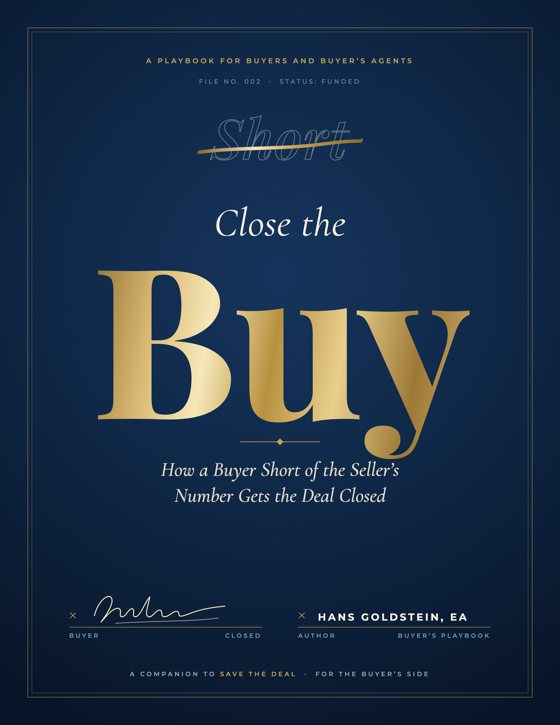
Close the BuyHow a buyer short of the seller's number gets the deal closed
You are not $400,000 short. You are one structure away. Offer what your buyer can pay, all cash at closing, and let the seller look at what they would keep. Your buyer's loan stays a normal loan, with no seller note to negotiate.
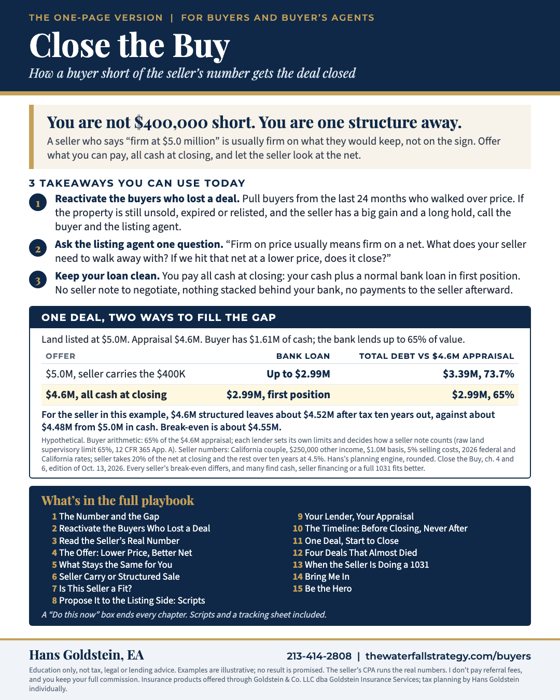
Ask the listing agent one question.
"Firm on price usually means firm on a net. What does your seller need to walk away with?"
Then, if the seller has a big gain and a long hold: "If we hit that net at a lower price, does it close?" You do not explain tax or give advice. You make one introduction, word for word: "There may be more than one way to get paid for this sale. I can introduce you to Hans Goldstein. He's a licensed insurance agent who compares the options with you and your CPA, and he's paid only if you choose one particular option. Want the intro?"
Spot the gap. Read the net. Make the offer.
Reactivate lost buyers
Past buyers who walked over price, and the properties that are still unsold.
Read the seller's net
"Firm at $5.0 million" usually means firm on what the seller keeps.
Lower price, better net
The price flex: a lower all-cash offer that can leave the seller about the same or more.
A clean loan for you
Your cash plus a normal bank loan, first position, nothing stacked behind it.
Carry or structured sale
Side by side, from the buyer's chair, and when a seller carry still wins.
Is this seller a fit?
A one-minute screen: big gain, long hold, sale not closed, gap under about 10%.
Scripts for the listing side
Email, text, call, voicemail and the objections, word for word.
Your lender and appraisal
What to tell the lender, when, and how a lower price closes an appraisal gap.
The buyer pays in full at closing. The loan stays a normal loan.
What it does for your buyer
- The buyer pays all cash at closing: own cash plus a normal bank loan, through escrow.
- The loan stays a normal loan, sized and approved by the lender's own rules, in first position.
- No seller-carry note to negotiate: no rate, no balloon date, no subordination fight, no servicing.
- The buyer makes no payments to the seller afterward.
What to know
- The seller's payments are locked in: no speeding up, borrowing against or cashing out. That is what protects the timing.
- They depend on the assignment company's ability to pay; it is usually funded by a fixed annuity from a life insurer whose name and financial-strength ratings are disclosed in writing before anyone signs.
- In many programs the buyer stays secondarily liable if the payer fails; the documents control, and the buyer's attorney reviews them.
- It must be arranged before closing. There is no published IRS ruling on this specific assignment structure, so the seller's CPA reviews the documents. A seller carry, cash or a full 1031 can fit better.
Every example on this page is an illustrative composite: a hypothetical buyer and raw land, with seller numbers from Hans's planning engine (2026 federal and California rates). Many sellers who run the numbers find that cash, seller financing or a full 1031 fits better. The seller's CPA runs the real numbers.
Get Close the Buy and the one-page version.
Read it in twenty minutes. Download instantly, and we will email you the links.
- Reactivate the buyers who lost a deal: the 24-month pull, call, text and email scripts for the buyer and the listing agent, and a tracking sheet
- One deal followed all the way: a $400,000 gap closed at $4.6 million, with the numbers
- The price flex, from Hans's planning engine: tax in year one and what the seller has ten years out
- What stays the same for the buyer, and what the buyer signs
- Seller carry or structured sale, side by side, with the stacked-note math
- The seller-fit screen, and when it does not fit
- Word-for-word scripts for the listing side
- Your lender and your appraisal; the timeline: before closing, never after
- Four deals that almost died, and when the seller is doing a 1031
- A "Do this now" box at the end of every chapter
- My offer: propose it through the listing side and I will call the seller, free
Send me the playbook
PDF playbook + one-page version.