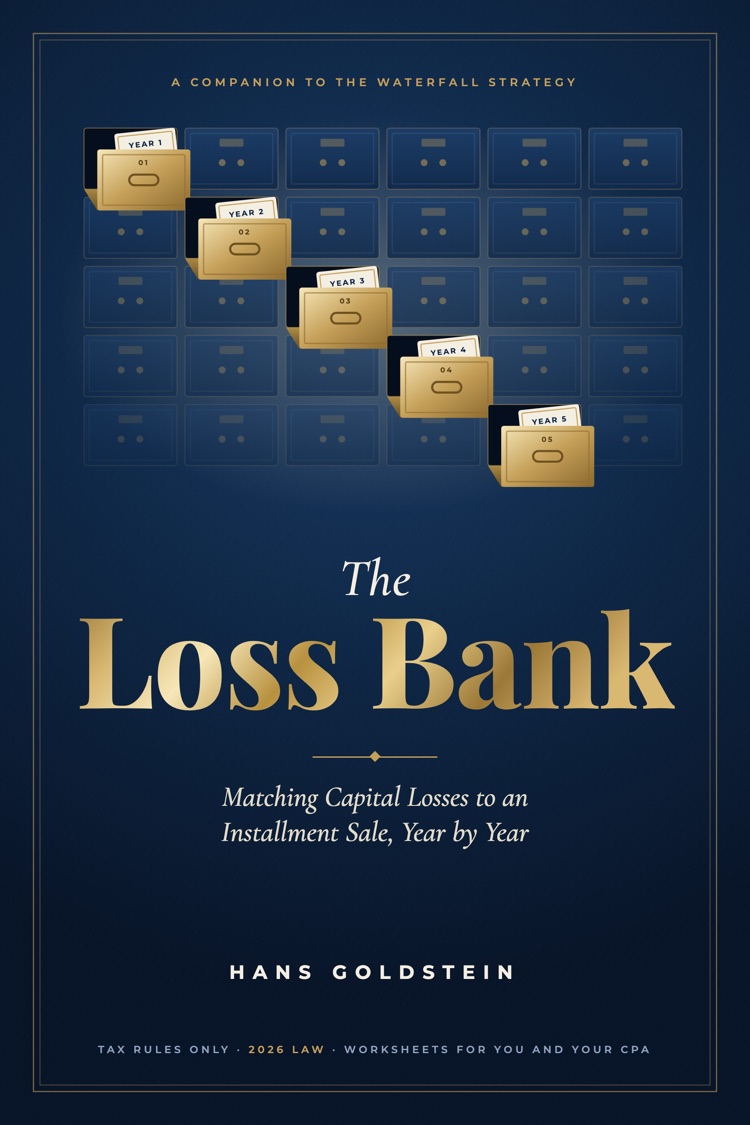
New · A companion to The Waterfall Strategy
Same losses. Same gain. A different calendar.
Selling a building or a business, and holding capital losses on your tax return? Sell for cash and the gain lands in one year. Sell on the installment method and it lands on a schedule you know before closing, so a loss that shows up in year three has gain waiting for it. The Loss Bank is the tax rulebook for matching the two, year by year, with worksheets for you and your CPA.
Same $500,000 of losses, same $2,000,000 gain: $32,362 more on the installment calendar.
What the losses were worth in federal tax. Illustrative composite from Chapter 9, 2026 tables, federal only. Not a projection; your numbers will differ.
A capital loss is a coupon. The installment schedule tells you when the store is open.
Against capital gain, a capital loss counts dollar for dollar. Against wages, pensions or interest, it's worth $3,000 a year. So the question isn't only how many losses you have. It's whether there's gain on the return in the year they land.
The bank
The carryforward on last year's Schedule D, plus any capital losses that land on your return in later years. The book covers which losses count, which never will, and the rules that can wipe one out.
The calendar
On the installment method you're taxed as you're paid (IRC §453). The schedule in the contract tells you, before closing, how much gain lands on each year's return.
The scoop
A scoop is the loss your return uses against one year's installment gain. One scoop a year, sized to that year's payment. Your CPA sizes each scoop from the losses on your return.
"One scoop a year, sized to that year's payment."
Shape the schedule to the scoops
Illustrative composite (the Chens, Chapter 9): a $1,000,000 gain; a $100,000 carryforward plus $40,000 of capital loss on the return each year for ten years, as given by their CPA. Same gain, same losses, two calendars.
The gain runs out in year 5. Years 6 to 10: $40,000 a year lands with nothing to meet but the $3,000 allowance. $185,000 still unused.
Every year's scoop has a payment to meet. $0 unused.
Dollar figures: what the losses were worth in federal tax over ten years, with the 3.8% tax, 2026 tables held constant. Interest, time value and reinvestment left out. Illustrative only; a longer schedule also means more note interest (ordinary income) and later money. The book covers both.
This is tax timing only. Whether losses land on your return at all, and how many, is a question for your investment adviser. The book never tells you to buy or sell anything. It shows what your return does with the losses once they're there.
Two ledgers, one return.
Written for you if
- You're selling, or about to sell, real estate or a business with a large gain.
- You have a capital loss carryforward on last year's Schedule D.
- You hold a taxable brokerage account where capital losses may land on your return.
- You're weighing a cash sale against seller financing or a structured installment sale.
- You want to walk into your CPA's office with the right questions and a worksheet.
Not for you if
- You want someone to tell you what to buy or sell. That's your investment adviser.
- All of your investments sit in IRAs or 401(k)s. Losses there never reach Schedule D.
- Your only sale is a home fully covered by the §121 exclusion.
- You want a promise of zero tax. Losses reduce the gain taxed in a given year; that's the claim.
Does it help in your state?
California taxes capital gain as ordinary income, up to 13.3%, and follows the federal loss rules. With no lower layer, every loss dollar that meets gain saves your full California rate.
The gain stays California-source. Your portfolio losses are sourced to your home state, so they don't reduce it (FTB Schedule D (540NR) instructions). They still cut your federal tax.
Tap a state on the map, or choose one from the list, to see how capital losses meet installment gain there, for residents and for nonresidents selling property in that state.
Ratings are plain-English summaries of state rules checked against state tax agency instructions and statutes on the date shown. Rules change; your CPA confirms yours.
The book has a "Your state" section in Chapter 8 with a ten-state table, and the full table for all 50 states and DC in an appendix. Educational summary only; not tax advice for your facts.
Thirteen short chapters, six worksheets, and every citation your CPA will ask for.
Part I: The idea
- 1Two Ledgers, One ReturnWhy a capital loss is a coupon, and why the calendar is the lever.
- 2What's in the BankFinding your carryforward; what counts, what doesn't; short-term and long-term passbooks.
Part II: The rules
- 3The Netting OrderWhich layer of your gain a loss hits first: up to 10 cents more per dollar.
- 4Every Kind of Loss That Can Meet Your GainCapital losses, passive losses and the deductions around them: a map, not a menu.
- 5Rules That Can Disqualify a LossThe wash sale rule, where it hides, and losses to family.
- 6What Losses Can't Touch§1245 recapture, note interest, §1231 netting.
- 7The 3.8% Tax and Your BracketsHow a loss lowers the top of the stack.
- 8State Tax: Your State, California and the Nonresident TrapA ten-state table and the resident vs. nonresident split.
Part III: The calendar
- 9The Schedule Is the LeverYear by year, electing out, and why the bank closes at death.
- 10Why a Bank Runs LowWhat published research finds, stated as findings, not predictions.
- 11The WorksheetsSix of them, from "what's in the bank" to "the state check."
- 12Questions for Your CPA and Your Investment Adviser
- 13Structured Sale or Seller FinancingPlus the appendix: loss rules for all 50 states and DC.
Worksheet 4: your scoop schedule.
Each year's payment next to the scoop it needs. Your CPA fills in the gain from the payment schedule and the losses from your return. Here it is filled in for the Chens' ten-year level schedule, to show the method.
| Year | Installment gain that year | 25%-layer portion | Losses available | Scoop needed to zero the gain | Gain still taxed | Left in the bank |
|---|---|---|---|---|---|---|
| 1 | $100,000 | $100,000 | $140,000 | $100,000 | $0 | $37,000 |
| 2 | $100,000 | $100,000 | $77,000 | $100,000 | $23,000 | $0 |
| 3 | $100,000 | $0 | $40,000 | $100,000 | $60,000 | $0 |
| Yours | $ | $ | $ | $ | $ | $ |
| . |
Year one: a $140,000 bank against a $100,000 scoop. The $40,000 excess takes $3,000 off other income and $37,000 rolls to year two. Illustrative only; losses are given numbers from the return.
Get The Loss Bank, free.
Leave your first name and email and download it right away. We'll also email you the link.
- The netting order, the wash sale rule and the 3.8% tax, in plain English
- Worked examples with every number traced
- Six worksheets, including the scoop schedule and the state check
- The state-by-state table: 50 states and DC
- A "For your CPA" citation box in every chapter
Send me the free book
Instant download, plus the link by email.
Buy The Loss Bank
$9.99 · PDF + EPUB · download link by email, good for 30 days.