For 1031 exchange advisors and trust representatives
Keep the ExchangeWhen to exchange part and structure the rest
A 4% loan becomes a 7% loan. A client wants some cash. A landlord is tired of buildings. Exchange the part that fits, plan the rest before closing, and you are paid on an exchange that closes.
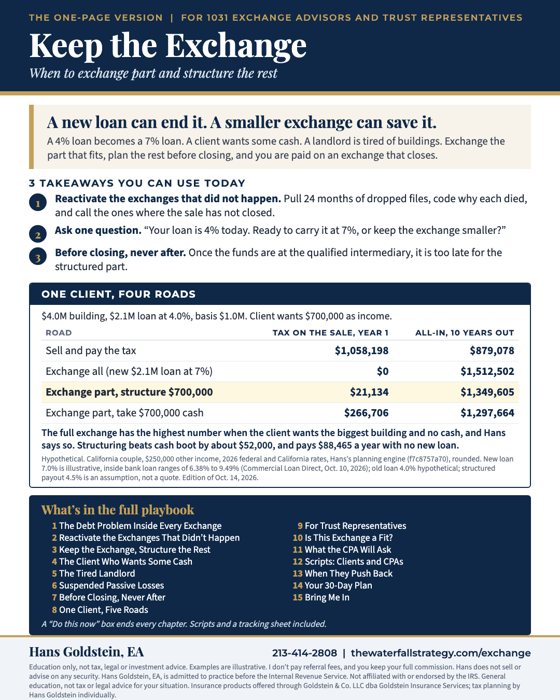
Ask your client one question.
"Your loan is 4% today. Are you ready to carry it at 7% on the replacement, or would you rather keep the exchange smaller?"
If the answer is a number, or "tell me more," make the introduction. You do not explain tax and you do not give advice. The introduction, word for word: "There may be more than one way to handle the part of this sale the exchange won't place. I can introduce you to Hans Goldstein. He's an Enrolled Agent, admitted to practice before the IRS, and a licensed insurance agent who compares the options with you and your CPA, and he's paid only if you choose one particular option. Want the intro?"
Reactivate. Size it. Say it clean.
Reactivate dropped exchanges
The last 24 months of files, coded by why each died, and which ones a structured sale fixes.
The debt problem
A 4% loan becomes a 7% loan: $47,347 more a year on $2.1 million.
The client who wants cash
Carve the cash out before closing instead of paying tax on it in one year.
The tired landlord
A smaller building or a Delaware statutory trust, plus a structured slice.
Suspended passive losses
The combination: an exchange, some cash and a structured sale.
Before closing, never after
Once the funds are at the qualified intermediary, it is too late.
One client, five roads
A worked example with dated, sourced rates.
Scripts for clients and CPAs
Call, voicemail, text and email, with the objections answered.
Exchange the part that fits. Plan the rest before closing.
What it does for you
- You keep the exchange alive when the new loan or the cash question would end it.
- The qualified intermediary stays in charge of the exchange; your replacement fee is unchanged on the part reinvested.
- Trust representatives: the client commits a part, with scheduled money for the rest.
- You give no tax advice: one question, one introduction.
What to know
- The seller's payments are locked in: no speeding up, borrowing against or cashing out, and they depend on the assignment company's ability to pay; it is usually funded by a fixed annuity from a life insurer whose name and ratings are disclosed in writing before anyone signs.
- A structured sale does not cure mortgage boot, and the part reinvested is smaller, so your replacement commission is smaller than on a full exchange.
- It must be arranged before closing. There is no published IRS ruling on this specific assignment structure, so the client's CPA and attorney review the documents.
- A full exchange, or cash, can fit better. Hans does not sell, recommend or advise on any security.
Every example on this page is an illustrative composite: a hypothetical building, a 7.0% replacement loan and a 4.5% payout as assumptions, with tax numbers from Hans's planning engine (2026 federal and California rates). Many clients who run the numbers find that cash or a full exchange fits better. The client's CPA runs the real numbers.
Get Keep the Exchange and the one-page version.
Read it in twenty minutes. Download instantly, and we will email you the links.
- Reactivate the exchanges that did not happen: the 24-month pull, why each died, which ones a structured sale fixes, scripts for the client and the CPA, and a tracking sheet
- The debt problem: a 4% loan at 7%, with dated rates
- The client who wants cash, the tired landlord, and suspended passive losses: the combination
- Before closing, never after: the timeline and the documents
- One client, five roads: sell, exchange all, exchange part and structure, exchange part and take cash, structure it all
- For Delaware statutory trust representatives: the debt arithmetic, lock-up and compliance
- Is this exchange a fit, and what the CPA will ask
- Call, voicemail, text and email scripts, objection answers and a 30-day plan
- A "Do this now" box at the end of every chapter
- My offer: introduce me with the client's OK and I will call, free
Send me the playbook
PDF playbook + one-page version.