For lenders and loan officers
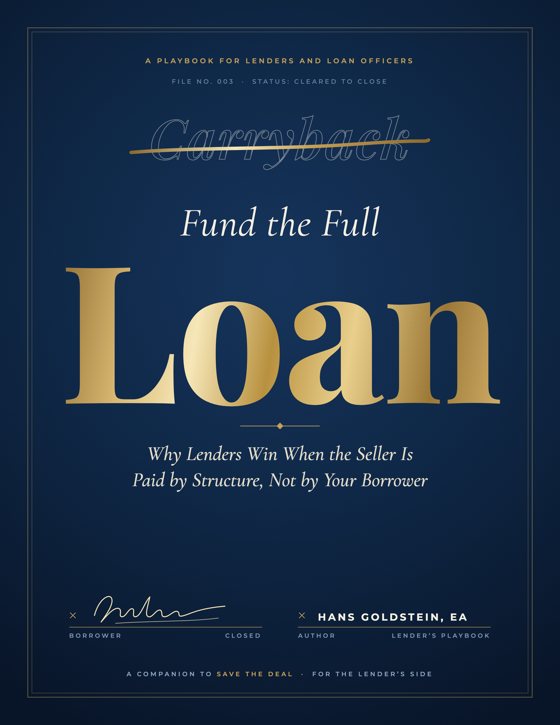
Fund the Full LoanWhy lenders win when the seller is paid by structure, not by your borrower
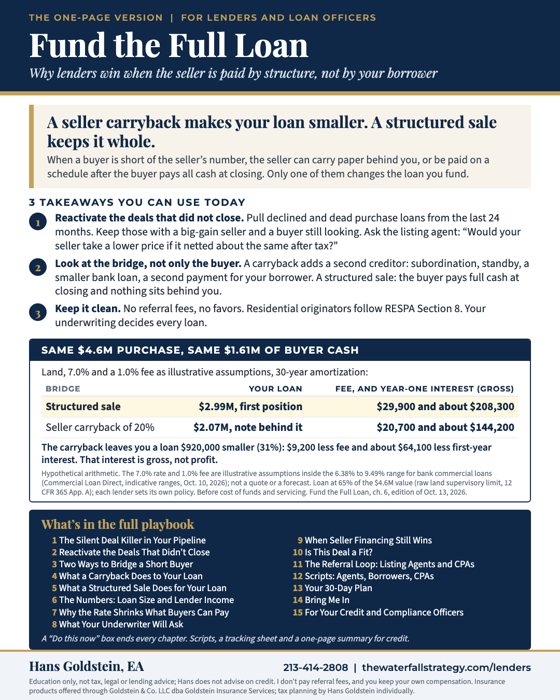
A seller carryback makes your loan smaller. A structured sale keeps it whole. When the buyer pays all cash at closing, you fund the full loan in first position, the deal closes and your loan is a normal loan.
Ask the listing agent one question.
"Would your seller take a lower price if it netted about the same after tax?"
If the answer is yes, or "tell me more," make the introduction. If it is no, thank them. You do not argue price and you do not explain tax. The introduction, word for word: "There may be more than one way to get paid for this sale. I can introduce you to Hans Goldstein. He's a licensed insurance agent who compares the options with you and your CPA, and he's paid only if you choose one particular option. Want the intro?"
See the bridge. Compare the loan. Say it clean.
Reactivate old loans
Declined and withdrawn purchase loans from the last 24 months, and the listing agents to call.
Two ways to bridge
Seller carryback or structured sale: what each does to the file you underwrite.
What a carryback does
A smaller loan, a second lien, subordination and standby, a second payment for your borrower.
What a structured sale does
The buyer pays all cash at closing. You fund the full loan in first position.
Loan size and lender income
The same purchase, side by side, with the arithmetic and the gross-not-profit caveat.
What your underwriter will ask
The contract clause, the assignment, secondary liability, concessions, SBA.
The referral loop
Listing agents and CPAs: how it comes to you, with no fees, no favors, RESPA first.
Scripts and a 30-day plan
Word for word, for agents, borrowers and CPAs.
The buyer pays in full at closing. You fund the full loan.
What it does for your loan
- The buyer pays all cash at closing: the buyer's cash plus your loan, through escrow.
- Your loan is a normal loan, sized and approved by your own policy, in first position.
- No seller note behind you: no subordination, no standby, no intercreditor negotiation.
- The seller holds no lien and no note on the property from the structured part.
What to know
- A structured sale does not give the buyer a seller's low rate; the buyer pays your rate on the whole loan. Seller financing still wins for some deals, and the book says when.
- The seller's payments are locked in and depend on the assignment company; it is usually funded by a fixed annuity from a life insurer whose name and ratings are disclosed in writing before anyone signs.
- In many programs the buyer stays secondarily liable if the payer fails; ask your credit officer how your policy treats that obligation.
- It must be arranged before closing. Hans does not advise on credit, and your underwriting decides every loan.
Every example on this page is an illustrative composite: hypothetical raw land, a 7.0% rate and a 1.0% fee as assumptions, with seller numbers from Hans's planning engine. The interest shown is gross, not profit. The lender decides every loan.
Get Fund the Full Loan and the one-page version.
Read it in twenty minutes. Download instantly, and we will email you the links.
- Reactivate the deals that did not close: the 24-month pull of declined and withdrawn loans, scripts for the borrower and the listing agent, a tracking sheet and the compliance notes
- The silent deal killer: how the rate shrinks what buyers can pay, with the coverage table
- What a carryback does to your loan, and what a structured sale does instead
- Loan size and lender income, side by side: $2.99 million against $2.07 million on the same purchase
- What your underwriter will ask, and a one-page summary for your credit and compliance officers
- When seller financing still wins, and the fit screen
- The referral loop with listing agents and CPAs, kept compliance-safe (RESPA Section 8)
- Word-for-word scripts and a 30-day plan
- A "Do this now" box at the end of every chapter
- My offer: tell the listing agent, and I will call the seller through the agent, free
Send me the playbook
PDF playbook + one-page version.